
The ravines, which are sharp, steep mud hillocks, stretch over three states - Madhya Pradesh, Rajasthan, and Uttar Pradesh, once home to several dreaded dacoits have long been the subject of several projects and government schemes to make them agriculturally viable.
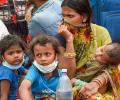
Only two in every five migrants said they received ration or cooked food from the administration either daily or at times.
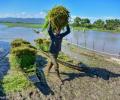
Reports said that in Telangana and Karnataka, excessive rains the past 10 days has threatened the standing green gram and maize crops and could negatively impact yields if the skies don't open up. But in the north-west and central parts of India, the resurgence of monsoon could not have come at a better time as oilseeds and pulses crops would otherwise had weathered if the rains didn't revive in August.

The restrictions imposed in March led to a sharp slump in demand from bulk consumers like hotels, restaurants, and roadside tea stalls, as they were forced to shut down. Sales of major milk products such as ice-cream, butter milk, and cheese, which usually spike during summer, also dropped.

The situation could become more acute as millions of migrants who had returned to their villages during the lockdown come back to the towns for higher wages and better livelihoods.

Swarms of immature pink locusts and adult yellow locusts are currrently active. Not only are fresh locusts swarms expected to arrive in the coming weeks, but even those already present in India have mated and are breeding new offspring.
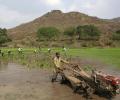
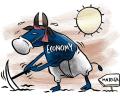
Much of the rural recovery story is based on the premise of agriculture doing well. Even if it clocks a growth of 2.5-3 per cent this year, it is still just around 15 per cent of the overall GDP. The non-farm sector, which constitutes a bigger portion of the overall rural economy, is now hampered by disruptions and lockdowns.

The plan could mature into either an umbrella programme for urban youths similar to the Garib Kalyan Rozgaar Abhiyaan or a modified urban-focused version of MGNREGS.

The met department said that rainfall in August is projected to be within the normal range at 97% of LPA. In August and September, India receives around 43 mm of rainfall.
However, demand was still much higher compared to the previous years, underlining the scheme's vital role in providing employment to the rural poor, a vast majority of whom are migrants.

Any shift in investor sentiment may result in speculators fleeing the gold market, driving its price down sharply, quickly. One significant risk for gold is a near-term reversal in the dollar, which recently fell to a two-year low.
The demand for milk and milk products slumped during the Covid-19 lockdown mainly from hotels, restaurants, sweetmeat shops which were shut to control the spread of the disease.

Between June 1 and July 28, about 32 per cent of the 685 districts in the country did not receive adequate rainfall.

Those interested in investing in gold have shifted to instruments, such as sovereign gold bonds and gold ETFs. Many others are, in fact, selling gold or using it as collateral to generate short-term liquidity.

The current wage revision for PSBs, as well as some private lenders, is due from November 2017 for five years - up to October 2022.
Distributing chana is easier than other varieties of pulses as it only requires cleaning and sorting and can be consumed whole; it was also abundantly available with Nafed.

The all-time high price of silver is Rs 75,000 a kg, recorded in April 2011.
Kerala, Punjab, Telangana and Andhra Pradesh are among the major agriculturally important states that have banned the use of glyphosate citing its adverse impact on human health.

'We have already sanctioned loans worth over Rs 3,000 crore to around 120,000 customers.'

Apart from Bihar, Chhattisgarh and Jharkhand, where none of the estimated 6.7 million construction workers got cash transfer benefits, the coverage of the construction workers was the lowest in Delhi, where only about 5 per cent of the estimated workers received cash under the PMGKY, followed by Kerala and Uttar Pradesh (22 per cent), among major states. In India, construction workers belong to the unorganised sector but account for the highest share of non-farm jobs after manufacturing.
 © 2026 Rediff.com - Investor Information - Advertise with us - Disclaimer - Privacy Policy - Sitemap - Feedback - About us - Terms of use - Grievances